Average Reviews:

(More customer reviews)`What's a Cook to Do?' by cooking teacher extraordinare, James Peterson is the best handbook of cooking techniques I have seen due to its excellent organization, the quality of the advice, and the great good humor of the author. This ranking includes placing it above a similar work, `Julia's Kitchen Wisdom' by the legendary Julia Child, which is no mean feat.
The book falls into a rather small niche of culinary works. It is not a `scientific' work like those from Alton Brown (`I'm Just Here for the Food') and Shirley Corriher (`Cookwise'). It is also not a formal manual of professional cooking techniques like Jacques Pepin's `Complete Techniques' or the author's own `Essentials of Cooking'. The best recent book in it's category is the issue from `Fine Cooking' magazine, `How to Break an Egg', which I liked quite a bit, but Peterson's book is better. If you are a `foodie', you will want both, but if you feel you only want one, Peterson's is the one to get.
The major reason lies in the fact that as in all of Peterson's books, he writes with the kind of good humored common sense which engenders trust in his advice, even more than his impressive resume as a chef, author, and teacher. The best symptom of this common sense is revealed when his advice is simply more accurate than that offered in `How to Break an Egg' for example. Both books correctly warn against leaving a stock in the dangerous temperature range that encourages bacterial growth. But, on two points, Peterson's advice is superior. First, he more correctly identifies the upper range of the danger zone to be 140 degrees Fahrenheit rather than `Fine Cooking's 120 degrees. Second, Peterson points out that as long as the stock is above the danger point, applying coolant is a waste of ice. The trick is to apply the cooling just as the stock reaches the danger point, in order at that time to bring it down as quickly as possible to the safe 40 degrees Fahrenheit.
Speaking of stocks, Peterson visits the old chestnut about freezing stocks in ice cube trays and storing them in the freezer. The problem with that is that to maintain a reasonably sized stockpile, you need a pretty large freezer. His solution is to have the stocks reduced to a light syrup, at about 1/15th of their original volume, then freeze the goodies in trays for making miniature ice cubes, so a teaspoon sized cube will reconstitute to more than a quarter of a cup of stock.
Like Julia Child's little book, Peterson's work has a fair share of complete recipes for those really important skills which you should really learn by heart. This includes recipes for stocks, biscuits, crepes, omelets, marinara sauce, pesto, pie and tart pastry, meringue, breaded veal cutlets, and cheese puffs. While many of these recipes may not be as complete as you may find in `Mastering the Art of French Cooking' or even Peterson's other books, they almost always bring out the essentials, and sometimes, a few surprises. In the summary of the meringue technique, for example, he points out that the best way to begin is not as one may expect (fast). The best thing to do is start slowly. And, he suggests that you will get more out of your hands before they give out if you start with your weaker hand and switch to beating with the stronger hand when that gets tired.
Peterson does repeat a few things from his `Essentials of Cooking', such as the technique for tying up a salmon steak, but I didn't see a lot of repetition. He is also not afraid of contradicting his earlier works, as when he gives advice on roasting a duck. In his `The Duck Cookbook', he gives a recipe for roasting a whole duck, but in this book, he suggests that the best tactic with duck is to disassemble it and roast its parts individually, as the fatty breasts require much different time than the leaner legs. Similarly, he points out that the best technique for roasting birds in general varies greatly by the size of the bird. It is best to brown very small birds in a saute pan first.
The finishing chapter is almost whimsical, as it is a few pages on etiquette at the restaurant dining table.
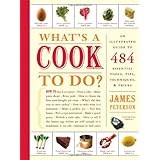
The photographs accompanying the tips are generally excellent, although they are a bit on the small size. The competition generally has none at all, so Peterson steals a march there as well.
His opening chapter on cooking tools is excellent, but it is not as complete as, for example, Alton Brown's excellent treatise on cookware, `Gear for Your Kitchen'. All his advice is sound, and very professional, especially when he recommends some serious gear such as a food mill, china cap and a drum sieve.
The only major weakness I found in the book is that it had no bibliography. There are few tools in the kitchen better than good advice about which books to go to when you want to know a particular skill. But then, the competition had no bibliography either.
Lastly, I simply found this book enjoyable to read from cover to cover. You can't beat that!
Click Here to see more reviews about: What's a Cook to Do: An Illustrated Guide to 484 Essential Tips, Techniques, and Tricks
From America’s favorite cooking teacher, multiple award-winner James Peterson, an invaluable reference handbook.Culinary students everywhere rely on the comprehensive and authoritative cookbooks published by chef, instructor, and award-winning author Jim Peterson. And now, for the first time, this guru-to-the-professionals turns his prodigious knowledge into a practical, chockablock, quick-reference, A-to-Z answer book for the rest of us.Look elsewhere for how to bone skate or trim out a saddle of lamb, how to sauté sweetbreads or flambé dessert. Look here instead for how to zest a lemon, make the perfect hamburger, bread a chicken breast, make (truly hot) coffee in a French press, make magic with a Microplane. It’s all here: how to season a castiron pan, bake a perfect pie, keep shells from sticking to hardcooked eggs. How to carve a turkey, roast a chicken, and chop, slice, beat, broil, braise, or boil any ingredient you’re likely to encounter. Information on seasoning, saucing, and determining doneness (by internal temperatures, timings, touch, and sight) guarantee that you’ve eaten your last bland and overcooked meal.Here are 500 invaluable techniques with nearly as many color photographs, bundled into a handy, accessible format.
 Get 40% OFF

0 comments:
Post a Comment