Average Reviews:

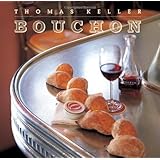
(More customer reviews)Expectations for Thomas Keller's new book `Bouchon' are very high, and I firmly believe he has exceeded them. The book sets new standards for the foodie coffee table fare as well as confirming Keller's reputation as one of the country's foremost culinary artists. The book is larger, heavier, and better than his first cookbook on the cuisine of his flagship French Laundry. There are several things that make this an excellent book for all people who love to cook.
First, the book is a superior reference work of bistro dishes and how to prepare them. It is certainly not complete, but then I think no cookbook in the world will ever be a complete reference to any subject, as every culinary subject changes daily due to changes in provisions, historical research, and the enormous variety in how even one dish is made from place to place. For example, both `Bouchon' and Tony Bourdain's recent book on bistro recipes from Les Halle has five (5) dishes containing mussels, yet no two are the same dish. For all of the virtues of Bourdain's book, Keller's book is superior as a reference to the overall style of cooking if only because he and his editors rigorously give both French and English names to all dishes.
Second, as amazing as it is to say this, lots of dishes in `Bouchon' are actually easy to make. The initial roast chicken recipe is literally not much more complicated than carefully prepping the carcass and sticking it into the oven. Keller does not even baste the beast and it is done within an hour (for a 3-pound bird). And, all this with the cachet of making a Thomas Keller recipe. Almost all the salads and `openers' dishes are equally as simple, as long as you have high quality ingredients.
Third, the pantry chapter of recipes is a more complete reference for making stocks and other sauce bases than I have seen anywhere else. My former gold standard for stockmaking recipes was in `The Zuni Café Cookbook' by Judy Rodgers. This is better by giving recipes that are just as good, better written, and a more complete collection of stocks than I have seen anywhere else. The only thing I would possibly add to this chapter would be a recipe for a court bouillon. But, the recipe does appear in the book as a part of the recipe for a shellfish platter. Other sauces such as a mignonette sauce and a cocktail sauce also appear `in situ' along with appropriate dishes with which they are used.
Fourth, the book is simply packed with important culinary techniques. Most of these are not the sort of thing which will find their way to the quick tips pages of `Cooks Illustrated' or `Gourmet' as they are not shortcuts, but more painstaking ways to improve what is probably already an excellent dish. One dramatic example is Keller's twist on braising where he segregates his flavoring vegetables at the bottom of the Dutch oven under a layer of cheesecloth before adding the meat and the broth. In this way, it becomes very easy to remove the finished meat from the veg and retrieve the broth with little or no odd floating bits of celery leaf or thyme branch. A more simple technique is the recommendation to transfer finished stock to the filtering device with a ladle rather than simply pouring the stuff into the chinois. The force of the uncontrolled flow will force some unwanted particles into the filtered stock. It is all about little details piled up upon one another, which separates good from great cooking.
Fifth, Keller's interpretation of bistro cooking is uncompromising. One dramatic example of this is his claim that America has forgotten how to make a proper quiche, if it ever did know in the first place. The cardinal sin is to make a quiche in a pie pan. This is no surprise, as Julia Child in `Mastering the Art of French Cooking' gives the same warning. What is more surprising is that while most Americans probably use a tart pan with sides of no more than an inch and Child recommends a flan or cake pan with sides up to 11/2 inches, Keller states that you need a 2 inch tall pan to make a proper quiche. A more subtle difference is in his technique for preparing his pate brisee. Virtually every pie crust recipes I have ever seen calls for cutting in butter to leave lentil-sized bits of butter in the mix. Keller insists this is a mistake for a quiche with a wet custard filling, as the pockets of butter create weaknesses in the dough that may break through before the custard filling has firmed up.
Although the book contains many simple recipes, there are also many classic recipes such as boeuf bourguignon, which are literally essays in classic French cooking. Tony Bourdain's recipe for boeuf bourguignon requires 10 ingredients and two concise paragraphs to describe the method. Keller's recipe calls for 43 ingredients in 5 different component preparations, not including the veal stock preparation. This recipe is the poster boy for Keller's take on bistro cooking, which is technique and constant refinement by filtering, skimming, and straining. While the authors have been painstaking in translating the professional's practiced eye and nose into English, this cooking is still about constant attention to the state of the dish as it cooks, and of recognizing the right time to move from one stage to the other. It is this dish where if Bourdain did it at the French Laundry his way, he would be fired on the spot.
This book is so large that it will probably be unwieldy to cook from in the kitchen. Open, it is large than two of my cutting boards together. Still, I cannot overstate how valuable this book is to someone who loves to cook and to read about cooking.
Very highly recommended.
Click Here to see more reviews about: Bouchon
 Get 37% OFF

0 comments:
Post a Comment