Average Reviews:

(More customer reviews)I'm impressed by a chef that quotes Gautama Siddharta, lists an individual portioned coulibiac recipe, a chile rellenos recipe, tells how to pipe Duchess potatoes, and informs that potatoes are sold in 50 lb cartons with "count size" from 40 to 120 potatoes in a carton. It gets better when he salts (bitter) purple eggplant, then further instructs to put a weight on top to remove excess water (these steps are not needed for smaller or non bitter eggplants-I don't salt my eggplants, and no happy eater has been the wiser). He double-fries french fries for tastier crispier results. He sautes often with unsalted butter, albeit clarified, for taste.
He puts grilled or sauted meats over a puree of garlic potatoes, to soak up juices...He correctly assigns the origins of Caesar Salad and Cobb Salads...he mentions polyphenol oxidase, the enzyme that causes unsightly browning of cut fruits and vegetables. Yes this is an experienced chef with a touch of food science, a la Harold McGee, painlessly dispensed as useful hints.
He suggests sauteing in heavy, stainless steel lined copper or aluminum pans, for fast heat transfer and optimal control.He premixes salt with ground black or white pepper, to speed up salt and peppering when put in a shaker or "dredge".
He gentlemanly names and compliments his chef-mentors, (whereas other bitter cookbook writers such as Susur Lee, backstab those who helped, and can not defend themselves in print).
This is a good general book for beginner to intermediate cooks, with lots of hints that do not appear in many recipes.
Some drawbacks follow, minor at that, such that in a creme caramel recipe he instructs inserting a toothpick to check doneness, assuming a cook knows what to look for, without telling what to expect.
I saute not with his clarified unsalted butter or his expensive extra virgin olive oil (EVOO), but often prefer a mix of unsalted butter with vegetable oil, or less expensive olive oil, as the heating destroys the delicate flavor of EVOO. There's a better "butter taste" when using nonclarified unsalted butter, when mixed with a corn, safflower or other oil.
There's no mention of the crunchier panko bread crumbs in recipes as a possibility. He doesn't mention brining, in a salt and sugar solution, for a juicier and tastier chicken or turkey, though he does put chicken to be fried in buttermilk bath, a good alternative. I prefer somewhat lumpy mashed potatoes with butter first added, then milk and some cream. He prefers smooth and lump free potatoes, with milk added before only 2 tablespoons of butter for six potatoes, making a soggier less creamy tasting and less distinctive mashed potato. There's no right way, you just may get more compliments with certain ways....and more calories too, so you be the judge of taste vs calories.
For making a Cassoulet, he does not tell how long to boil and soak the beans, or say what is the desired consistency of the beans for the best taste and results. He bakes the cassoulet only one hour at 425 degrees, rather than several hours at a lower heat and slower rate, to better mix the flavors. Most savvy chefs cook a soup or stew, refrigerate it overnight to let the taste get fuller and richer, then cook it again the next day, as stews and soups taste generally better the second day.
Many of the recipes are reasonable shortcuts of longer ones, that may or may not taste quite as you may have tasted in other homes or restaurants. That's fine for this sort of book...if you want you can "Google" similar recipes from the internet, open other cookbooks, and see how others fix them, and adapt your own recipe. Better you cook a good recipe, than be intimidated and avoid a lengthier recipe until you are at that stage of cooking comfort. I use any recipes as just a rough guide, and not something carved in stone. (Don't improvise in baking recipes, unless you have some baking experience, as the results may be disheartening).
The awkward quirky index is only listed by broad headings such as Breads, Dessert, Main Course, Salads, Sides, etc., and not alphabetically as in most books by the name of the dish, or with a section listing by main ingredients. If you want Oysters Rockefeller, it won't be listed under "Appetizers", you must mindread, and look under "Main Course". Want to make "french fries"? They are not listed as "French Fries", or silly "Freedom Fries". Chef Carey is a bit fancy here, and lists them as "Pommes Frites Allumettes". You get the picture. Good luck.
This book would have been much better if checked over by a professional cook or cookbook writer as proofreader, to catch these and other errors, such as noting , on the first page, his favorite text, the distinguished Escoffier's Le Guide Culinaire" to have a mere "over 500" recipes, instead of over 5 thousand recipes.
The black and white quickly hand drawn illustrations are few, feeble and generally useless. A shame when a few color or even B&W pages of finished dishes could really sell a recipe, or in this case, the book. So many of my beginning to intermediate cookng friends thrive on color or well done B&W pictures, as suggestions on beautiful plating appearances,and choose cookbooks with some photos as a major criteria.
My praise is overall solid for this book, my criticisms few and really mild, in perspective. Overall, I take off one star, and give 4 stars for a cook-friendly book I recommend buying, with lots of practical advice.
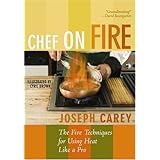
Click Here to see more reviews about: Chef on Fire: The Five Techniques for Using Heat Like a Pro
By demonstrating that all cooking breaks down to five simple procedures, Chef on Fire enables you to look at any recipe and instantly grasp the technique involved in it's cooking, the time it will take to prepare, and all the equipment needed. Each chapter includes an overview of a technique, which foods are appropriate for a technique, and approximately 25 recipes applying the technique. By juxtaposing various ethnic and regional recipes in each chapter, Carey demonstrates that applying the same five techniques consistently makes good food in every culture.

Click here for more information about Chef on Fire: The Five Techniques for Using Heat Like a Pro

0 comments:
Post a Comment