Average Reviews:

(More customer reviews)`Lidia's Family Table' is Lidia Matticchio Bastianich' fourth book and probably the 826th book on Italian cuisine published in English in the last 50 years. The book fully comes up to expectations of quality, given the very experienced team of Bastianich, editor Judith Jones, and publisher Alfred A. Knopf. So, why do we want to add another book on Italian cuisine, this book, to our collection?
The first part of the answer is that the book follows in the footsteps of Jacques Pepin's latest book where a prominent culinary writer / educator is writing about what they cook at home. And, they write about it in a way that makes it exceptionally useful for the amateur home cook. This means the book may be more useful to us than the first, a study of the cooking heritage of northeastern Italy based in Bastianich' homeland of Istria, near Trieste and Venice. Or the second, which is Lidia's survey of Italian cooking in general, or her third, which is her survey of `Italian-American' cuisine. Since reviewing this third book, I have read and reviewed several other books on `Italian-American' cuisine and I find Bastianich' work to easily lead the pack in overall quality of recipes.
Our current subject does not bill itself as `easy' or `fast' cooking, only as 'everyday cooking at home'. This seems to be a much more satisfying and realistic target for an author of good recipes. Since the fast cooking cookbook field is so crowded and so well dominated by Rachael Ray, why not do what you know best rather than trying to buy into a trend. This book is also not billed as being authentic anything. While a really excellent implementation of Italian cooking principles, there is no claim that these recipes come from anywhere but Ms. Bastianich' own imagination. And, I have absolutely no problem with this. The quality of a recipe is not in its pedigree as it is in the quality of the preparation and in the presentation of the technique. While this is all `home cooking', I suspect from the description of the work which went into the creation of the book that many of the dishes were created for the book or were borrowings from traditional recipes. But, this also doesn't matter.
One background fact about the book that may matter is that Ms. Bastianich is very true to her roots in both her creations and in her borrowings. That means that most of the recipes in this book are closer to the northeastern Italian terroir than they are to Rome, Naples, Apulia, or Sicily, the fountainhead of most `Italian-American' cuisine. This immediately makes the book more interesting than other recent offerings from southern Italian scions, Frank Pellegrino and Rocco DeSpirito. This means that Lidia's recipes are very heavily into meals based on rice, corn and fresh pasta than on dry pasta and tomato sauces. The most striking evidence of the influence from central Europe and Vienna is the excellent section on strudel recipes. This is the real deal, as Ms. B. gives us an excellent recipe and photo demonstration on how to make homemade strudel dough. Before you gasp in dismay, let me say that strudel dough as she describes it has more in common with thin pizza dough than the daunting thought of phyllo dough, which is often used as a substitute for strudel dough. I have used phyllo to make strudel and I am not happy with the result. So, I am tickled to find an expert presentation of strudel making for amateurs. The recipes are not even limited to apple strudel. The book covers strudel made from squash and cranberries plus a strudel purse done with prune and ricotta filling.
The blurb under the title on the dust jacket makes a point of saying that a major feature of the book is in `ideas for variations and improvisations'. I am very happy to say that this book does an excellent job of providing these suggestions where they are appropriate without straining the style as may have been done in the generally very good book, `Nightly Specials' is written by Michael Lomonaco. The notion of variations takes several different shapes in Lidia's book. The simplest and most obvious is in the discussion of a sauce which follows up with a list of all the types of pasta or other applications to which the sauce can be applied. A second kind of variation is demonstrated in the very first series of recipes for mackerel cured in olive oil. The series begins with a simple recipe for the cured mackerel, followed by applications of cured mackerel in a red onion salad, a bruschetta of cured mackerel and beans, and a mackerel and tomato salad. Leftovers, anyone?
In addition to the tutorial on strudel, the book contains an excellent lesson on making fresh pasta, including a large number of variations on the shapes of the finished noodles. The lessons on the strudel and the fresh pasta alone are worth the price of the book. But, it also includes lots of great sidebars on techniques for cooking Italian standards such as risotto, Minestre, sugo, and polenta. It is entirely consistent with her Italian roots that the book has lots of recipes for vegetables and few recipes for meat. In fact, Ms. B. says that the one thing Italian-American cuisine is missing is a well-balanced use of vegetables, especially leafy vegetables.
If I were to endorse this book for any one reason, it would be in Ms. Bastianich' excellent use of very large saute pans which are ideal not only for finishing pasta in pan, but also for incrementally sautéing various ingredients in the bare middle of the pan, while already sautéed ingredients are shepherded to the margins.
Many cookbooks have a limited audience. This book is an excellent resource for everyone. Very highly recommended.
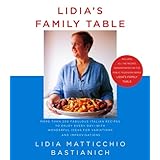
Click Here to see more reviews about: Lidia's Family Table: More Than 200 Fabulous Recipes to Enjoy Every Day-With Wonderful Ideas for Variations and Improvisations
 Get 34% OFF

0 comments:
Post a Comment