Average Reviews:

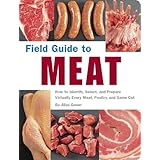
(More customer reviews)`Field Guide to Meat' by Aliza Green is part of the series of very handy pocket sized, sturdily bound, heavy covered paperbacks by Quirk Books. Ms. Green also wrote the `Field Guide to Produce' for the same series, to which I gave a very favorable review. This book, I feel, is even more useful as a volume you own and consult often. The difference may be less in the relative quality of the books but in the relative availability of good cookbooks and reference books devoted exclusively to meat and those devoted to fruits and vegetables. Vegetables as a group are supported by superb books from leading culinary writers such as Jack Bishop, Alice Waters, James Peterson, and most of all, Elizabeth Schneider and her volume, `Vegetables from Amaranth to Zucchini'.
Compared to these four, I know of only two leading writers, Bruce Aidell and the team of Schlesinger and Willoughby who have done good cookbooks covering a wide range of meats, and even these books don't give as broad a coverage as the veggie crowd.
These two books solve the amateur cook's knotty problem of wandering through the market, being able to tell what looks good, and then thinking up something to do with the good stuff. When I see some especially good looking pork chops, there is only one thing I can thing of doing with them. If I wanted to stuff them, I would not be sure I knew what I would need, as all my pork chop stuffing recipes are sitting on my bookshelf at home. With these books in hand, you will can get a much better idea of the variety of things you can do with a cut of meat from this book than from virtually any other source I can think of. This is not to say it isn't there, it's just that it is so spread out across so many different books and sources that if you don't already have it all in your head, tracking it down on short notice is almost impossible. The only single source I can think of which comes close to this book is the Larousse Gastronomique, but you don't want to be lugging this 10-pound boat anchor around with you at the Farmer's Market. And, my experience with the average meat market attendant is that I know more about meat than they do. All the real butchers are back in the cold room.
The books on produce and meats will generally be used for different things. Produce is generally much more perishable than meat in a refrigerated case. That is, the variability in the quality of produce at one store will be much higher than the variability in the quality of meat, especially since produce probably comes from 20 or 30 different suppliers, while beef, pork, veal, and lamb may come from two or three suppliers while poultry may come from two or three other suppliers. And, with the exception of lamb, practically all meat availability is independent of season. Therefore, while your first question upon opening the book on produce may be the seasonality, the first question upon opening the book on meat may be `What is a good cut for grilling?' or `How do I pick the best pork chop for stuffing?'.
While most cookbooks separate flesh on four legged animals from flesh from two legged / two winged animals, this book is just that much better because in addition to covering beef, veal, pork, and lamb, it covers all different types of poultry (domesticated birds) and game, including wild birds and wild mammals. In fact, the range of wild game mentioned is truly amazing. I was surprised to see the `Joy of Cooking' cover boar and muskrat. This book includes sections on alligator, armadillo, raccoon, rattlesnake, and squirrel. Just what they need at the road kill café! Much more practical is the fact that the book also covers all sizes, shapes, and nationalities of Charcuterie and meat preservation. It even mentioned some types of hams of which I have not yet heard.
Upon opening the book, the very first thing I did was to look up guanciale (cured pork jowl) in the index and lo and behold, there it was. This alone sold me on the book. Unfortunately some other index games came up empty, as when I looked up London broil. No references appeared anywhere in the index, even though it is mentioned in the introduction and as a method of preparation for several different cuts of meat.
This means that you can't effectively pick a cooking method and search for the best cut(s) to use with this method.
Otherwise, for a list price of $15, literally every American foodie needs a copy of this book, especially as the `Larousse Gastronomique' primarily deals with European butchering primals.
Very, very highly recommended.
Click Here to see more reviews about: Field Guide to Meat: How to Identify, Select, and Prepare Virtually Every Meat, Poultry, and Game Cut
What's the difference between pork sirloin and pork tenderloin? Are Spanish chorizo and Mexican chorizo the same thing? Do quail and pheasant really taste just like chicken?
Whether you're a casual griller or a haute foodie, you need the latest volume in our popular Field Guide series--Field Guide to Meat. With engaging text from award-winning chef Aliza Green, this illustrated guide shows how to identify and prepare more than 100 different kinds of meat, from beef and pork to lamb, poultry, wild game, sausages, and more. Featuring detailed descriptions, selection tips, and full-color photographs for easy identification, Field Guide to Meat is every carnivore's one-stop reference book.
 Get 32% OFF

0 comments:
Post a Comment